
There's a new bedtime song on the Sparkle Tree Studios YouTube channel, and it stars the calmest creature we could think of: a capybara.
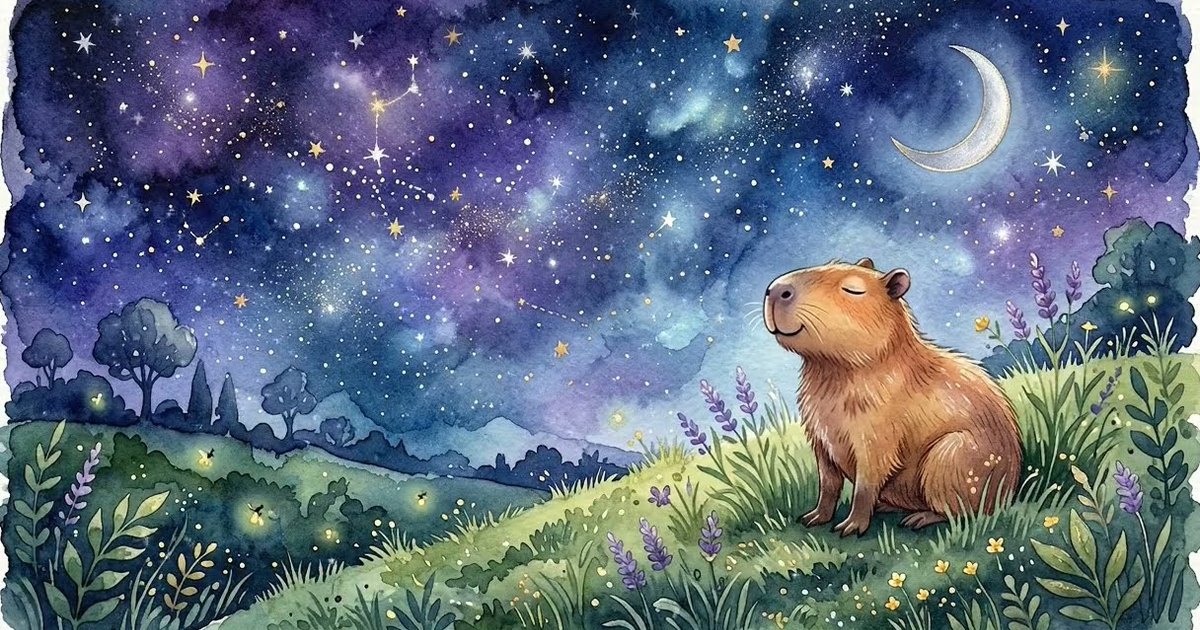
In our watercolour version of Twinkle Twinkle Little Star, a little capybara sits on a grassy hill at night, eyes closed, gazing up at a sky full of stars and a crescent moon. Lavender and wildflowers sway in the breeze around it while fireflies drift over the hills. That's the whole story, and that's the point: it's two gentle minutes made for the very end of the day.
Opens on YouTube. Find more of our songs on the Sparkle Tree Studios channel.
Why a capybara?
Capybaras have a reputation as the most relaxed animals around. They sit, they soak up the evening, and nothing much seems to bother them. That's exactly the mood we wanted for bedtime: not a character who's doing something exciting, but one who's slowing right down, the way we hope little ones will.
We kept everything in the scene soft. Watercolour washes instead of hard lines, a sky in deep blues and purples, and only small, slow movements: flowers nodding in the breeze, stars twinkling, fireflies floating by. There are no sudden noises or bright flashes to wake a sleepy brain back up.
The song
Twinkle Twinkle Little Star is one of the oldest lullabies in English. The words come from a poem called "The Star" by Jane Taylor, first published in 1806, sung to a French melody many children also know as the alphabet song. The first verse is the one most families know by heart:
How I wonder what you are!
Up above the world so high,
Like a diamond in the sky.
Twinkle, twinkle, little star,
How I wonder what you are!
Because it's so familiar, it's a song children can join in with long before they can read, and one you can keep singing after the screen goes off.
How to use it at bedtime
- Make it the last thing, not the first. Put it on once teeth are brushed and pyjamas are on, as the signal that the day is ending.
- Turn the brightness down. Dim the screen and the room before you press play.
- Watch it together. Point out the moon, the fireflies and the flowers moving in the wind, in a quiet voice.
- Then sing it without the screen. Once the video ends, put the device away and sing the verse again, softly, in the dark. The song stays; the screen goes.
- Keep it to one play. A two-minute song works best as a full stop, not a playlist.
A little activity for tomorrow
If your child loves the capybara, try a daytime follow-up: draw your own capybara sitting on a hill, then add the night sky. Count the stars as you draw them, give the moon a shape (a crescent, like in the video, or a full moon), and add your favourite flowers on the hill. Crayons or chalk on dark paper look especially lovely for a night scene.
We'd love for the capybara to become part of your goodnight routine. You'll find this lullaby and our other songs on the Sparkle Tree Studios YouTube channel.
▶ Watch the capybara lullaby on YouTube