
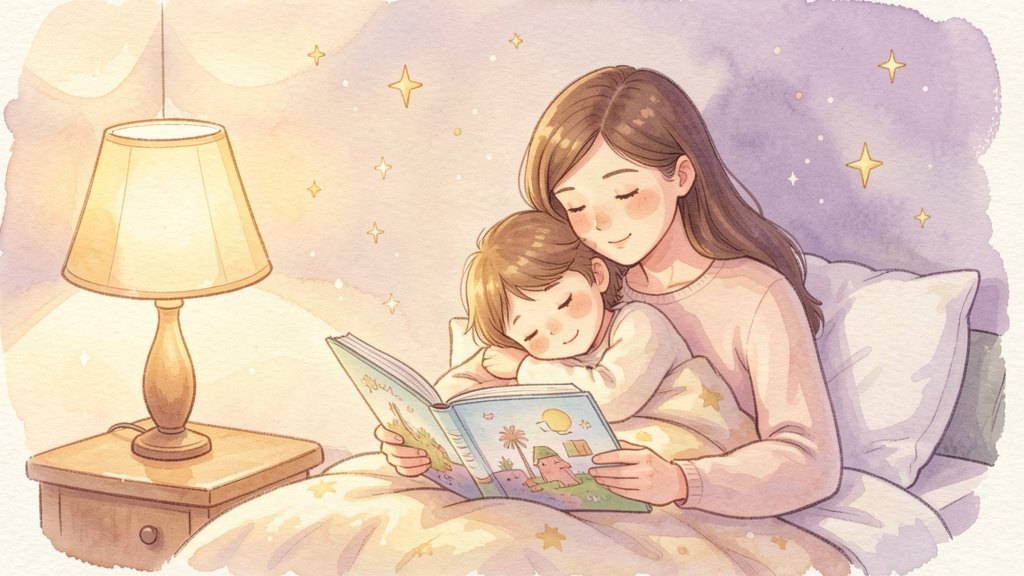
My neighbour's daughter started reception last September. Bright kid, chatty at home, but by October her teacher pulled my neighbour aside. "She's not picking up the phonics as quickly as the others," the teacher said. "Have you been reading to her at home?"
My neighbour was mortified. She works nights. Her partner works days. They tag-team childcare, and bedtime stories got lost in the shuffle of dinner, baths, and sheer exhaustion. She thought they were doing fine — they talk constantly, they sing songs, the kid knows her colours and shapes. But phonics? That's different.
Here's the thing that stopped me cold when I first read the research: children who are read to daily hear roughly 1.4 million more words by age five than children who are never read to. Not 1.4 million words total. 1.4 million words more. That's the gap.
Where the number comes from
The study came out of Ohio State University, published in the Journal of Developmental and Behavioral Pediatrics. Researchers analysed data from a nationally representative sample of American families, tracking how often parents read to children from birth to age five. They didn't just ask parents — they looked at actual book reading frequency and calculated the cumulative word exposure.
Children read to five books a day: about 1.4 million words more than children never read to.
Children read to one book a day: about 290,000 words more.
Even one book a week: about 63,000 words more.
These aren't small differences. They compound. Every time you open a picture book, you're not just reading a story — you're depositing vocabulary into a developing brain that hasn't built its word bank yet.
Why the gap matters
Vocabulary at age five predicts reading comprehension at age eleven. That's not my opinion — that's longitudinal data from multiple studies. Children who start school with smaller vocabularies don't just "catch up" later. The gap tends to widen because reading begets reading. Kids who know more words understand more of what they read, so they read more, so they learn more words. It's a cycle.
And here's what gets me: the words in picture books aren't the words we use in daily conversation. We speak in shorthand. "Put your shoes on." "Time for dinner." "Don't hit your brother." Picture books use complete sentences, varied sentence structures, and — crucially — words that don't come up in everyday life. "Gigantic" instead of "big." "Strolled" instead of "walked." "Furious" instead of "angry."
My friend's three-year-old recently described a tantrum as "catastrophic." She didn't learn that word from Peppa Pig. She learned it from a library book about a dragon who lost his favourite sock.
It's not just about the words
The Ohio State study focused on word count, but the mechanism is richer than that. When you read aloud, you're also modelling:
How stories work — beginning, middle, end. Cause and effect. Character motivation. These are comprehension skills that transfer directly to reading independently later.
Print awareness — that squiggles on a page represent spoken language, that we read left to right, top to bottom. Children pick this up by watching your finger track under the words.
Attention span. Sitting through a picture book takes practice. The child who can sustain attention for a ten-minute story has a massive advantage when they sit down with a chapter book in Year 2.
Emotional vocabulary. Books name feelings. "The bear felt disappointed." "The mouse was jealous." Children who can name their emotions regulate them better. That's not reading research — that's neuroscience.
The "good screen time" trap
I've had parents tell me, "But we listen to audiobooks in the car! That counts, right?"
It counts for something. Audiobooks build vocabulary and story sense. But they miss the joint attention piece — the parent pointing at the picture, the child pointing back, the back-and-forth that happens when you share a physical book. That interaction is where the magic lives.
And animated story apps? The ones where the book reads itself while the child taps sparkling stars? Those are closer to television than reading. The research on "interactive" e-books is mixed at best — the bells and whistles often distract from the narrative rather than enhance it.
It's why we like the Dream Machine at our sister site, Sparkle Tree Press. No games. No taps for rewards. Just animated pages and an optional read-aloud voice, paced for reading together. You sit together. You talk about the pictures. You turn the page when you're ready. It's screen time, yes — but it's shared screen time. There's a difference.
What this looks like in real life
You don't need five books a day. Nobody has time for five books a day unless you're a librarian or unemployed. The research shows a gradient — every book helps.
In our house, we aim for three picture books at bedtime. Some nights we manage one. Some nights zero because someone threw up or had a meltdown or I simply cannot read "The Gruffalo" one more time without losing my mind. That's fine. The average matters more than the perfect day.
We keep library books in a basket by the sofa. Not on a high shelf. Not in a rotation system. In a basket where small hands can grab them. The two-year-old pulls out "Dear Zoo" five times a day. The five-year-old has discovered the non-fiction section and brings me books about deep-sea creatures with questions I cannot answer. "Mummy, why does the anglerfish have a light on its head?" I don't know. We look it up together. That's reading too.
We also visit the library every Saturday. Not because it's "good for them" — because it's free, it's warm, and they have a train table. The books are a bonus. But the bonus adds up.
If you're starting from zero
Maybe you didn't grow up with bedtime stories. Maybe you're not a confident reader yourself. Maybe your child won't sit still. I hear you.
Start smaller than you think. One book. Two minutes. Let them turn the pages. Let them interrupt. Let them ask "what's that?" on every single spread. That's not derailing the story — that is the story.
If reading aloud feels awkward, try this: don't read the words. Talk about the pictures. "Look, a red balloon. Where's the blue one? Oh, the dog took it. Silly dog." You're still building vocabulary. You're still doing the joint attention thing. The text can wait.
And if you truly cannot — work shifts, literacy struggles, whatever — the library runs story times. Sure Start centres run rhyme times. There are free audiobooks on the Libby app with your library card. The Dream Machine at Sparkle Tree Press is free. There are options. You don't have to do it alone.
The bottom line
1.4 million words. That's the headline number, and it's staggering. But the real story isn't the number — it's what the number represents. Every word is a tiny deposit in a bank account your child will draw on for the rest of their life. Reading comprehension. Emotional regulation. Academic confidence. The ability to lose yourself in a story when the world gets too loud.
You don't need to be perfect. You just need to open the book.
Tonight. One book. Two minutes. That's 300 words deposited. Do it again tomorrow. That's how you close a gap — one story at a time.