
On 27 March 2026 the government published new advice on screen time for the under-fives, and within about an hour my sister had sent me three news links, two voice notes and a meme. The headlines mostly said "one hour max". That's accurate, as far as it goes. It's also the least interesting sentence in the whole document.
Here's what's actually in it, where I think the panel got it right, and what's changed in our house since March.
What the guidance actually says
The advice came out of an expert panel chaired by the Children's Commissioner, Dame Rachel de Souza, alongside Professor Russell Viner, a paediatrician who specialises in children's health. It lands in three parts.
For children under two, the recommendation is to avoid screen time altogether, other than for shared activities that encourage bonding, interaction and conversation. For two to five-year-olds, parents are advised to aim for no more than an hour a day, to keep screens out of mealtimes, and to keep them out of the hour before bed. And running underneath both of those: watch with your child. Talk about what's on the screen. Ask questions.
There's one carve-out that got far less coverage than it deserved. The time limits shouldn't apply in the same way to screen-based assistive technology used by children with special educational needs and disabilities. If your child uses a communication device or accessibility software, the panel is explicitly not asking you to ration it along the same lines. I know a couple of families who read the headlines, felt a familiar lurch of guilt, and needed exactly that sentence.
The clock is the least useful part
I'll admit my bias here: I've never got on with stopwatch parenting. An hour is a helpful anchor and a terrible target. Treat it as a budget to fill and you end up doing demented arithmetic, doling out fifteen minutes here and cutting bath time short there so the numbers balance.
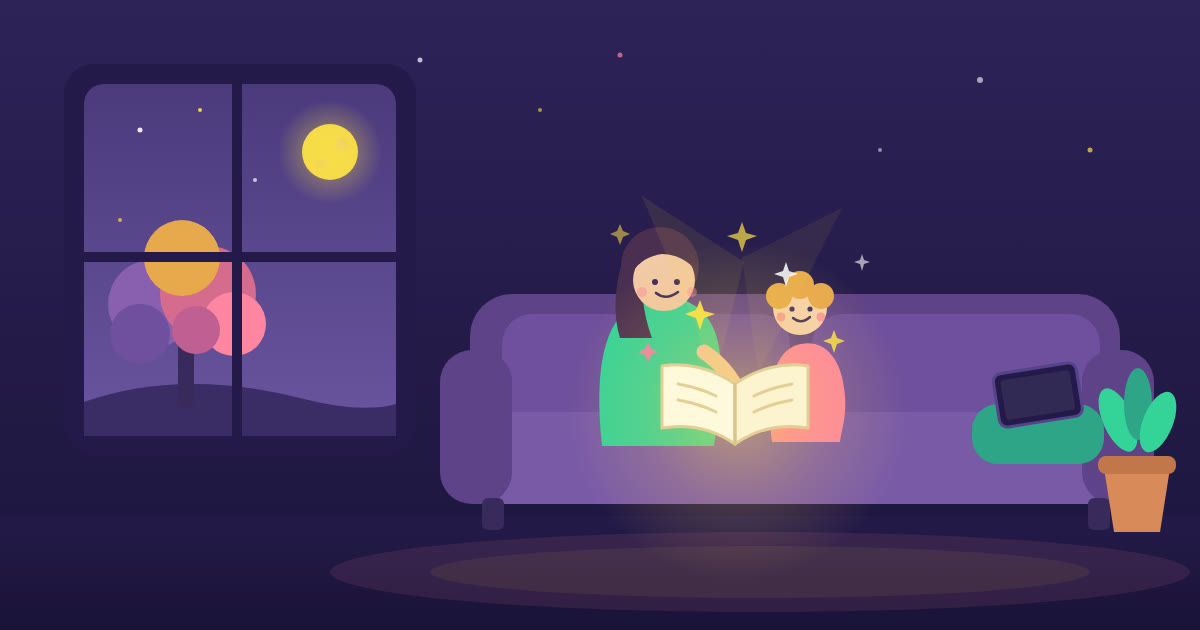
My neighbour's daughter is four. Her daily screen time is roughly what it was before March. What changed is the composition. Half of it is now spent with her mum squashed onto the sofa, working through an animated storybook together, and the other half is cartoons while her mum cooks dinner. Same minutes, completely different evenings.
What changed isn't really the duration, it's whether there's an adult in it.
Story time is the swap the guidance itself suggests
If you dig into the Best Start in Life material that accompanies the guidance, there's a section on what it calls safe screen swaps. At mealtimes it suggests background music, table games, colouring or I Spy. At bedtime it says it plainly: swap screens for reading bedtime stories together.
Now, an honest wrinkle, because I sell stories for a living and I don't want to sound like I'm wriggling. An animated book on a tablet is still a screen. The hour-before-bed rule applies to it exactly as much as it applies to anything else. What I'd argue, and what that under-two line quietly concedes, is that screen minutes aren't all the same weight. A story you watch together, talk over, and then hear re-enacted at bath time with a plastic dragon is doing the job the panel actually wants done: bonding, interaction, conversation.
The trick we use is timing. Screen-based story time happens around four or five in the afternoon, when everyone is frazzled and I need fifteen minutes of stillness before I start dinner. Bedtime stays paper. The Poppy the Dragon books from Sparkle Tree Press live on the bedroom shelf precisely for that slot, and the Dream Machine library on the same site does the late-afternoon one. It's not a perfect system, but it's a survivable one.
What "watching together" looks like on a Tuesday
Co-viewing sounds like a research term, all lab conditions and observation windows. In practice it's small and slightly silly. My friend Priya teaches reception, and she uses a rule she calls "two questions and a pause". She lets the story run, stops it once somewhere in the middle, asks one question about what's happened and one about what might happen next, then lets it carry on. That's it. Thirty seconds of her life.
You don't need to narrate over the top of everything. Over-talking is its own problem, and I say that as someone who has been shushed by a four-year-old. But children's stories are built for interruption. Why did the dragon sneeze? What would you have done? Where did the glitter go? Those questions work whether you're holding a picture book or watching one with audio narration.
Narrated animated books are genuinely handy here, and not only because the narrator has a better reading voice than I do at six in the evening. When the words are handled, your eyes are free. You can watch your child's face instead of the screen, which is where most of the useful information is.
What about the over-fives?
Worth saying plainly: this guidance stops at five, and your child doesn't. If there's a seven-year-old in your house, the panel has nothing for you, which is either refreshing or mildly terrifying depending on the day you've had. The principles survive past the cut-off, though. Content matters more than minutes, and company matters more than content. And sleep is the hill to die on: whatever else moves during the week, the hour before bed stays screen-free. That's the one rule I'd keep at every age in the house. Mine included, if I'm honest.
What we've actually changed since March
I'm wary of the genre where a parent lists seven flawless new habits. So, with the caveat that the tablet still gets used as a babysitter some evenings because dinner won't cook itself:
- Screens left the kitchen table. Music went on instead. The first week was loud with complaints, and then it wasn't.
- Everything stops an hour before bed, story apps included. Paper books only after that line.
- Shared viewing counts differently in our house, and I've stopped apologising for thinking so. If I'm sitting next to her and we're talking, that's family time.
- One question at the end, not a quiz. "What was your favourite bit?" does more work than anything I've read in a parenting book.
The guidance is advice, not law, and the panel says as much. Take the one-hour target if it helps you. Take the mealtimes rule, which I think is the single most useful line in there. And take the bit everyone skims: watch together, talk, ask questions.
Last week we watched the sneezing dragon one twice in a row because my daughter wanted to check whether the glitter came out of the dragon's nose the second time. It did. Two questions were asked and a conversation happened about whether dragons can be allergic to their own treasure. I'll take that over a stopwatch.